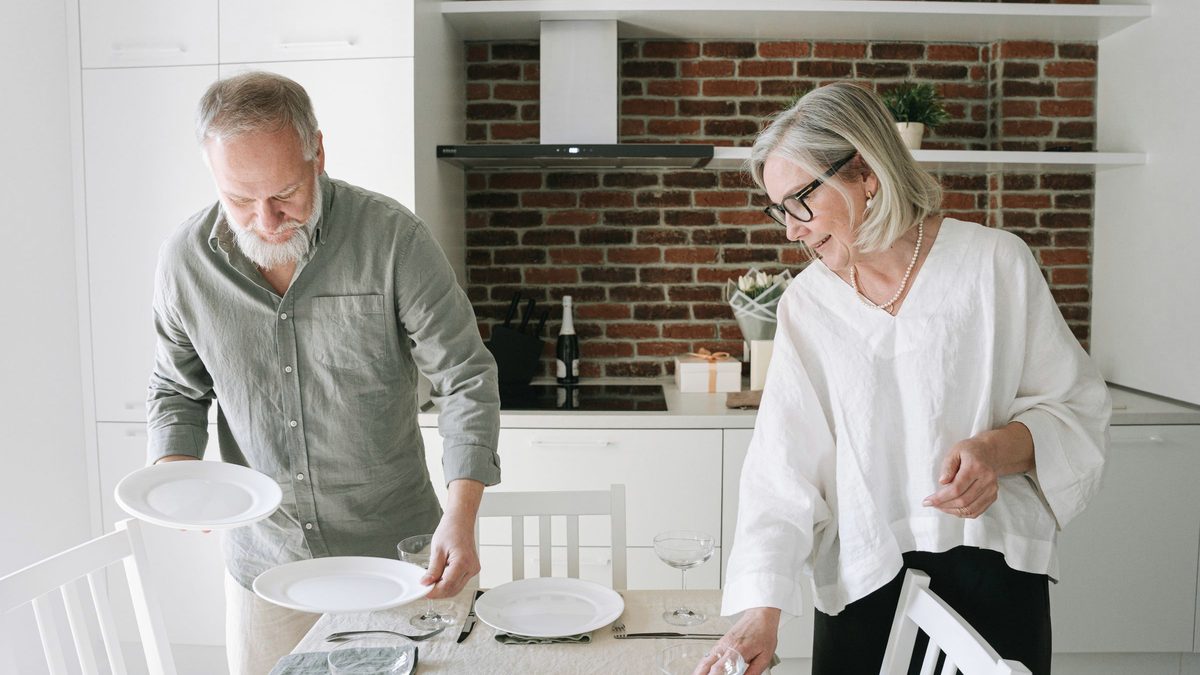
The first dinner for two
The car comes back empty. The boxes are in the student room, and the last "text me when you get there" has been sent. That evening, you set the table. Two plates. And a slightly strange silence settles in.
For years, the house revolved around the kids: schedules, homework, lifts, meals, worries. You were a very efficient team. And now here you are, face to face, with a question you may not dare ask out loud: "So what about us, now?"
Some people feel huge relief. Others feel real sadness. Many feel both at once, sometimes on the same day. All of that is normal.
"Empty nest syndrome": a cliché that's only half true
People often talk about "empty nest syndrome": the idea that parents, especially mothers, fall apart when the kids leave home, and that the couple wobbles along with them. The sadness is real, of course. Watching someone you raised for eighteen or twenty years walk out the door stirs things up.
But for the relationship itself, research tells a different story. Three psychologists at Berkeley, Sara Gorchoff, Oliver John and Ravenna Helson, followed a group of around a hundred women for eighteen years, from age 43 to age 61. They published their results in 2008.
What they found: women whose children had left were more satisfied with their relationship than women who still had kids at home. Their relationship improved, even though their life in general didn't change that much.
An honest caveat: the study only included women, from a single generation. So we don't know exactly whether men, or couples today, go through the same thing. But the message is encouraging: the kids leaving home is not, in itself, a threat to the relationship.
Not more time, but better time
The most interesting part of the study is the reason for this improvement. You might assume couples did better because they spent more time together. That wasn't the case.
The women didn't necessarily spend more time with their partner. But they enjoyed that time more. Fewer interruptions, less tiredness, no more "Mum, have you seen my keys?" in the middle of a conversation. Time for two finally became real time for two.
In everyday life, that means something simple: it's not the number of hours you spend together that counts, it's what you do with them. Half an hour of real conversation is worth more than a whole evening side by side in front of a screen, each lost in your own thoughts.
It's also advice for people whose kids are still small: the researchers pointed out that you shouldn't wait for the children to leave to make time to enjoy each other.
When you realise you only ever talked about the kids
There's a flip side. For some couples, the kids leaving reveals something they'd stopped noticing: for years, they only talked about them. Their grades, their friends, their problems, the logistics. Once that topic is gone, there isn't much left to say.
Other researchers, Jody VanLaningham, David Johnson and Paul Amato, followed a large, nationally representative sample of married people in the United States for seventeen years. They found no automatic "bounce back" in marital happiness as the years go by: on average, satisfaction tended to drift slowly downwards, at every stage of marriage. In other words, a relationship doesn't get better by itself just because the house empties. What you do with the time you get back is what makes the difference.
A few signs to look out for:
- Meals are silent, or always come back to the kids ("Have you heard from her?").
- You've each got used to doing things on your own.
- You struggle to remember the last time you laughed together, just the two of you.
- One of you feels lonelier than before, even though you're together more often.
If this sounds familiar, don't panic. It doesn't mean the relationship is over. It means you've given a lot to your family, and now it's time to find each other again.
 Duoly, the couples appThe evening date that puts the conversation back at the center.
Reconnecting, in practice
No need to fly off to the other side of the world for three weeks. Small things, repeated, matter more than grand gestures.
- Talk about it openly. "It's strange, this house without them. How are you finding it?" Putting words to the moment brings you closer.
- Change the subject, on purpose. At one meal a week, no talking about the kids. Talk about yourselves, a book, a memory, something you'd like to do.
- Ask questions you don't know the answer to. "What would you like to do, now that we have more time?" "Is there something you put aside all these years?" After twenty years, you think you know everything about each other. That's rarely true.
- Find something that's yours. A Sunday morning walk, a class you take together, a restaurant you never had time to try. Something that belongs only to the two of you.
- Try something new. Discovering something together, even something small, creates fresh memories that aren't about being parents.
- Make the house your own. What happens to the empty bedroom? Deciding together is already a small shared project.
This applies to every couple: those who had kids young and find themselves at 45 with a whole life ahead of them, blended families where the last child has just left, or two men whose daughter is moving abroad, discovering the quiet of a flat that suddenly feels too big.
When one of you takes it harder
Partners often don't experience this moment the same way. One can't wait to travel; the other feels a pang every time they walk past the empty bedroom. That gap can lead to misunderstandings: one feels misunderstood, the other feels held back.
What helps is welcoming your partner's sadness without trying to fix it. Instead of "Come on, he's fine, he's happy!", try: "You miss him, don't you. So do I, in a different way." And give each other time to adjust.
Remember too that your bond with your children doesn't disappear: it changes shape. Calls, visits, coming home for the holidays (or simply coming back to live at home for a few months) are all part of this new chapter.
If the sadness lasts, takes over everything, or comes with a deep sense of weariness, talk to a doctor or a therapist. It isn't weakness; it's looking after yourself.
And tonight? One question can be enough to turn a new page: "What would we like to experience, the two of us, in the years ahead?" You raised children together. You already know how to be a team. Now it's about being one for yourselves.