"We should really…" and then nothing
You've talked about it at least ten times. "We should go away for a few days to the coast." "We should take up tennis." "We should finally do something with that balcony." Then the week goes by, then the month, and the sentence stays a sentence.
Instead, your conversations revolve around laundry, groceries, and who's picking up whom at what time. Nothing dramatic. But one evening it hits you that life together looks a bit too much like a well-run flatshare.
If that sounds familiar, you're not alone. And the good news is you don't need a big project to get your spark back. You need a real one, even a tiny one.
Why shared projects feel so good
In the 1980s, two American psychologists, Arthur Aron and Elaine Aron, put forward a simple idea: we love feeling ourselves grow. Learning something, discovering a place, becoming a little more than we were yesterday. And when it's the relationship that helps us grow, we get more attached to it. At the start of a relationship, this happens on its own: everything is new. A few years in, it needs a little help.
A project together does exactly that. It gives you a story that moves forward, with a before and an after. You're no longer just running daily life side by side: you're building something together, and you can see yourselves doing it.
A Canadian study shows this well. Judith Gere, Ulrich Schimmack and their colleagues at the University of Toronto asked 194 married people to note, several times a day, what they were doing, who with, and how they felt. The happiest moments weren't simply the ones spent with their partner. They were the ones where the two were together and the activity mattered to both of them. In those moments, people also felt closer to each other, and that feeling of closeness explained part of their good mood. A second study, with 112 people in dating relationships, found the same thing.
Shared project or chore in disguise?
This is where many couples get it wrong. Not everything you do together is a couple project. Assembling furniture because you have to, renovating a bathroom under pressure, organising your mother-in-law's birthday: these can be fun moments, but they're often just more tasks, with their share of irritation.
Judith Gere later studied 105 couples with Ulrich Schimmack. The more partners felt their goals got in each other's way, that what one wanted clashed with what the other wanted, the less satisfied they were with their relationship, and the worse they felt about life in general.
In other words, a project only helps if it's truly shared. If one of you dreams of a marathon and the other signs up to keep the peace, it isn't a shared project. It's a silent sacrifice, and sooner or later it gets paid for. A few telltale signs:
- A real project: you enjoy talking about it, you look forward to the next step, and each of you brings something to it.
- A chore in disguise: one pulls, the other follows with a sigh, and you mostly talk about it to check "where we're at".
Backing your partner's projects counts too
Not every project has to be done as a pair. He wants to pick up the guitar again, she wants to change careers, one wants to write a book, the other is studying for an exam. These personal projects matter for the relationship too.
In 1999, a team led by Stephen Drigotas and Caryl Rusbult showed, across four studies, that people make more progress toward the person they'd like to become when their partner believes in them and actively helps them get there. They called it the "Michelangelo phenomenon", a nod to the image often linked to the sculptor: bringing out the statue already hidden in the block of marble. And those couples worked better together and lasted longer.
In everyday life, it looks like this: taking the kids on Saturday morning so the other can go to their class. Asking "So, how's that application going?" and really listening to the answer. Saying "I can see you doing that" rather than "Are you sure that's sensible?".
 Duoly, the couples appThe evening date that puts the conversation back at the center.
How to get started tonight
No five-year plan needed. Start small, and start real.
- Ask the question, no pressure. "If we had a project just for us for the next two months, what would it be?" Let each of you answer, without judging the ideas.
- Keep only what you both want. Not what would be "good to do", but what genuinely excites you. If nothing overlaps tonight, that's fine: ask again next week.
- Think small. Baking a decent loaf of bread, doing a hike in every corner of your region, learning a few phrases of a language before a trip. A small project finished does more good than a big one abandoned.
- Give it a date. A project without a date stays a "we should really". A first step in the calendar, however modest, changes everything.
- Split roles by what you enjoy. One loves researching, comparing and planning; the other prefers getting stuck in. That's perfect: what matters is that each of you has a part.
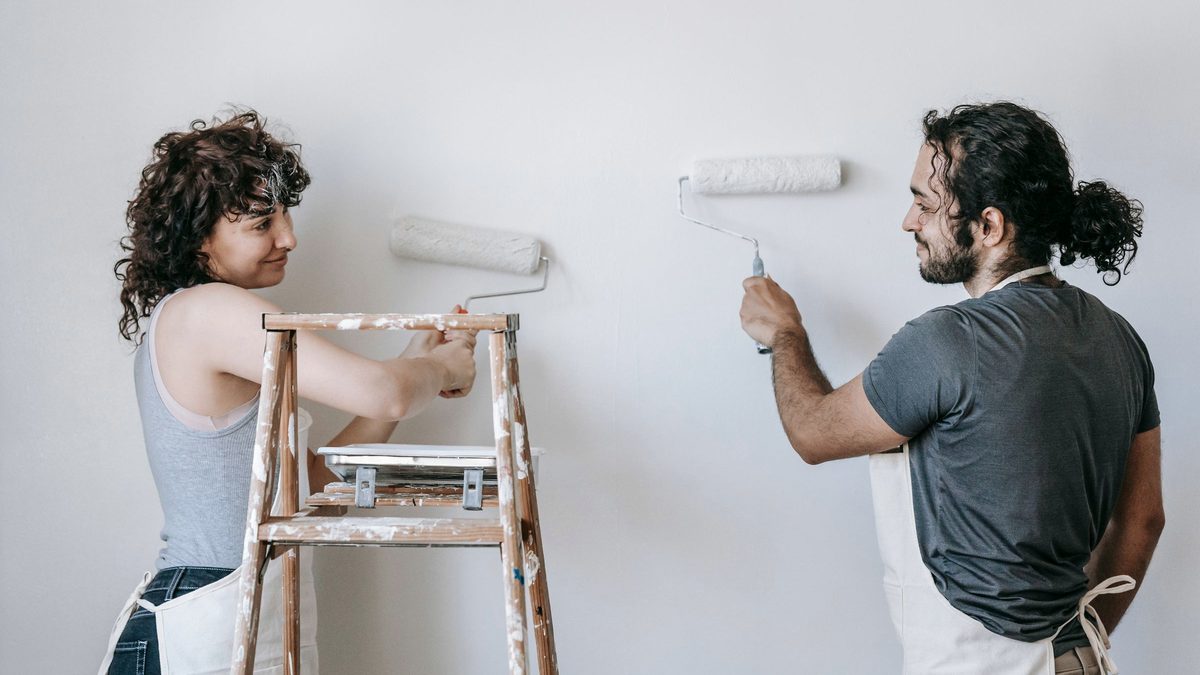
- Celebrate the milestones. A photo of the first failed loaf, a drink when the room is finally painted. These little moments become part of your shared story.
For every couple, at every stage
Projects look different depending on your life. A young couple might dream of their first big trip. Busy parents might settle for a twenty-minute project on Sunday evenings once the kids are in bed, like learning to cook a dish from another country. Two people living far apart can read the same book or take the same online course, and talk about it on their calls.
What matters isn't the size of the project, it's the feeling of moving together toward something you both enjoy. And if a project runs out of steam, that's not a failure: it's a chance to pick a new one.
So tonight, instead of yet another "we should really", try a "what if we…". With a date.