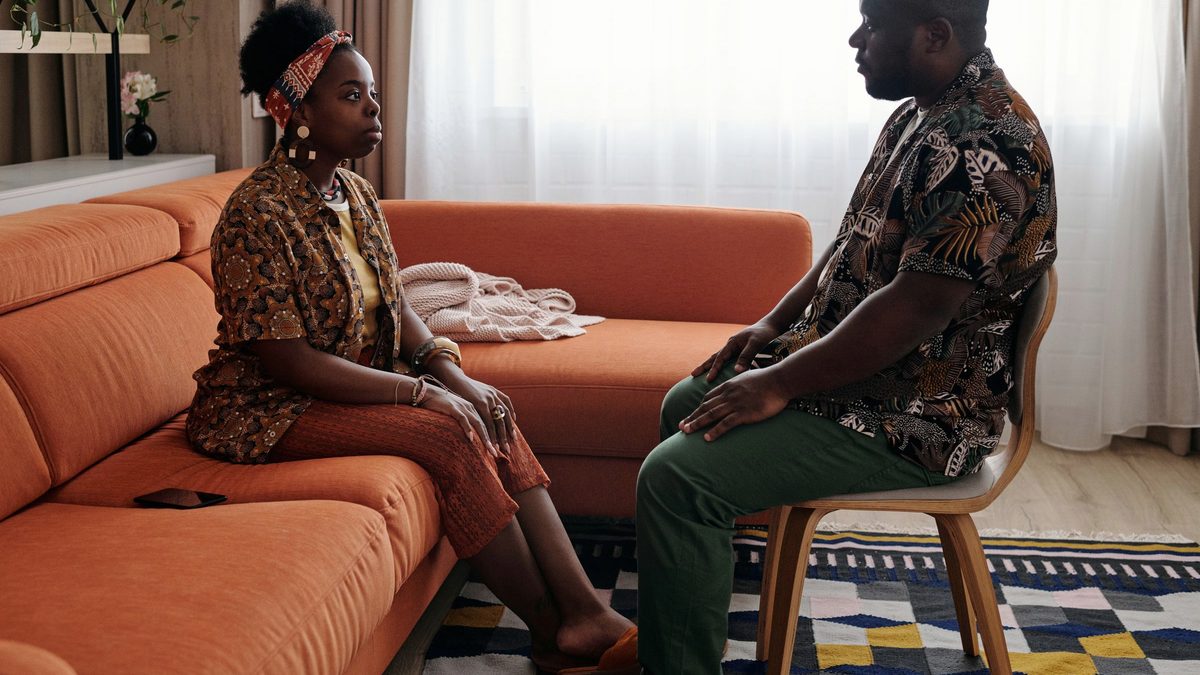
When you wonder whether you'll make it
Things have been stuck for weeks. Every small remark turns into an argument. Or the opposite: you don't even argue anymore, you just pass each other politely, like two tired flatmates. At night, one of you pretends to be asleep. The other scrolls through their phone without seeing anything.
And one question keeps going round in your head: "Are we losing each other?"
A crisis can come at any time. After a baby arrives. During a move, a job loss, a bereavement. After finding out something that hurt. Or for no clear reason, just because tiredness has piled up. It happens to new couples and to couples who've been together for twenty years.
The first thing to know: going through a crisis doesn't mean your relationship has failed. Plenty of couples who are doing well today have been there. What makes the difference is often how you go through it.
The real problem: the loop, not the person
In a crisis, we tend to put our partner on trial. "You never listen to me." "You're always on my back." Each of you gathers evidence, and each of you feels accused. The relationship turns into a courtroom.
Canadian psychologist Sue Johnson, who created an emotion-focused approach to couples therapy, suggests looking at it differently. In her view, what damages the relationship isn't one person or the other. It's the loop both of you are caught in.
A very common example: one partner pushes, demands, criticizes, because they're afraid of no longer mattering. The other shuts down and pulls away, because they feel attacked and don't know what to do. The more one pushes, the more the other withdraws. The more the other withdraws, the more the first one pushes. Each reacts to the other's reaction, and nobody remembers who started.
In this approach, the first step is to spot this loop together, and even give it a name. "Here we go, the merry-go-round again." Suddenly, the enemy isn't the person in front of you. It's the merry-go-round. And against that, you can be on the same team.
It isn't just a nice idea. A team of researchers including Stephanie Wiebe and Sue Johnson followed 32 couples after this kind of therapy: two years later, they were still more satisfied with their relationship, and felt safer with each other, than when they started.
What researchers learned by following couples for five years
At the University of California, Los Angeles, psychologist Andrew Christensen and his colleagues ran a large study with 134 married couples in serious trouble. Not a rough patch: couples who had been unhappy for a long time and were often thinking about splitting up.
These couples were followed for five years after therapy. The result: about half were clearly doing better than when they started. About a quarter had separated. The last quarter hadn't really changed.
It isn't a fairy tale, and that's exactly what makes the number valuable. Even when things are very bad, many couples can still find a way out.
Christensen's approach rests on an idea close to Sue Johnson's: step back a little and look together at what's happening between you, without deciding who's wrong. Like two people looking at a problem placed on the table, rather than two opponents facing off. It also stresses acceptance: you won't change someone's personality. But you can change how you react to the things about them that drive you up the wall.
The small word that changes the tone: "we"
Another study, run at the University of California, Berkeley by Benjamin Seider and Robert Levenson, looked at a detail that seems tiny: the words we use during an argument.
They filmed 154 couples discussing a sore subject, while also measuring their physical reactions, like heart rate. Couples who said "we" and "us" more often stayed calmer, both in their bodies and in how they behaved. They were warmer and less hostile. Those who talked mostly in terms of "you" and "me" were harsher, and less happy in their relationship.
You won't save a relationship by swapping three pronouns. But these words say something: do you see yourselves as a team with a problem, or as two sides?
Compare:
- "You never make an effort" becomes "We're stuck right now, and I don't like what we're turning into."
- "You always walk out in the middle of the conversation" becomes "We struggle to finish our conversations. How could we do it differently?"
 Duoly, the couples appThe evening date that puts the conversation back at the center.
Where to start, in practice
You don't have to wait until you've found a therapist to take a first step. Here are simple things to try this week:
- Pick the right moment. Not at 11pm after an exhausting day, not by text. Suggest: "Could we sit down on Saturday morning and talk about us?"
- Describe the loop, not your partner. "When I criticize you, you shut down, and the more you shut down, the angrier I get. I think we're both stuck in this thing."
- Say what's under the anger. Behind a complaint there's often a fear or a need. "Actually, when you come home late without telling me, I'm scared I don't matter to you anymore."
- Own your part, without carrying it all. "I know I get defensive a lot, I'm going to watch that." A sentence like that disarms far more than a long explanation.
- Take a break before it blows up. If things get too heated, say so: "I can't listen properly right now. I'm going for a walk and we'll pick this up in twenty minutes." And really come back.
- Keep one gentle moment. Even in the middle of a crisis: a coffee together, a walk, a film without talking about the problems. It reminds you why this relationship is worth fighting for.
And if you keep going round in circles despite your efforts, seeing a couples therapist isn't admitting failure. It's often the quickest way off the merry-go-round, because someone on the outside can see what you no longer can.
When it's no longer a shared problem
Everything above assumes one thing: that you're both suffering from the situation, and that each of you feels safe with the other. If one partner is afraid, humiliated, monitored, threatened or hit, this isn't a "loop" to fix together. The priority then is to stay safe and get help, from a domestic abuse helpline in your country or from emergency services.
For everyone else, remember this: a crisis is a time when a couple hurts each other, but also a time when it can learn to talk better. The crisis doesn't decide what happens next. How you choose to look at it does: face to face, or side by side.
Tonight, there's only one thing to do. Not fix everything. Just say, one way or another: "I don't want us to lose each other. Shall we figure this out together?"