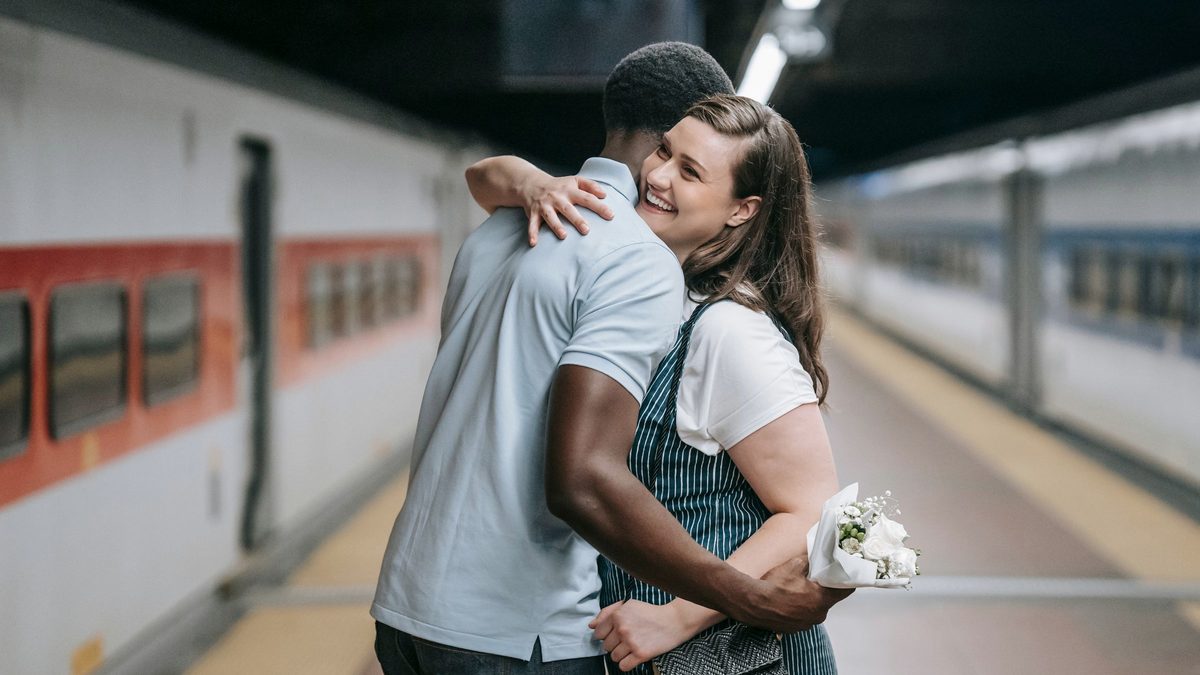
Sunday evening on the station platform
The weekend went by too fast. You hold each other one last time on the platform, or at the airport security gate. Then the train leaves, and there's that little empty feeling in your chest. Tonight it'll be a video call again, the phone propped against a mug, and the screen freezing at the worst moment.
Lots of couples go through distance, for a few months or for several years. A student off on a year abroad. A new job in another city. Two people who met on holiday and live in two countries. Parents where one works far away during the week and comes home on Friday night.
And the opinions come quickly: "Long distance never works." Yet what researchers have found is far more reassuring. And far more interesting.
Out of sight doesn't mean out of mind
At the University of Denver, Andrew Kelmer, Galena Rhoades, Scott Stanley and Howard Markman surveyed 870 people in relationships across the United States. Some lived near their partner, some far away. Then they compared.
The result was surprising. People in long-distance relationships weren't less happy. Quite the opposite: on average, they felt more in love, had more fun together and rated their conversations as better. They also felt more committed to their relationship, and less "stuck" in it.
In other words, distance doesn't automatically wear love down. For many couples, it even pushes them to look after the bond more deliberately: you set dates, you plan, you say things out loud.
Why you can feel closer when you're far apart
Two researchers at Cornell University, Crystal Jiang and Jeffrey Hancock, wanted to understand how this could be. They asked student couples, some long-distance and some in the same city, to log their exchanges every day for a week: calls, texts, video chats.
The long-distance couples talked less often, but felt closer. Two things explained it. First, they opened up more: when you only have one call to connect, you don't waste it on the shopping list. You get to the heart of things, to how you feel. Second, they had a more flattering picture of their partner and their relationship.
That second point is sweet, but it hides a trap. From a distance, you mostly see the best version of the other person: the one who got ready for the call, the one from weekends that feel like a little celebration. You don't see the tired Tuesday-night version, or the pile of laundry, or the mood before the first coffee.
The truly fragile moment: when you're finally together
We often think the danger is the separation. Research suggests it can also come when the separation ends.
In the study by Kelmer and his colleagues, long-distance couples started out more confident: they thought they were less likely to break up within the year. A few months later, the researchers checked in again. The long-distance couples had broken up just as often as the others. Their optimism hadn't protected them.
Laura Stafford and Andy Merolla, at Ohio State University, looked more closely at what happens when long-distance student couples end up living in the same city. While they were apart, these couples were fairly stable, often more so than close-by couples. But once they were together, a large share broke up. And the ones most likely to split were precisely those who had idealized each other the most, and who had seen each other little in person during the distance.
It's not that these couples loved each other less. It's that they suddenly discovered everything the distance had hidden: the little habits, different ways of handling money or housework, the need for time alone, the topics you avoided so as not to spoil your weekends together. Everyday life arrives, and with it arguments you'd never had before.
 Duoly, the couples appThe evening date that puts the conversation back at the center.
What helps while you're apart
The good news is that you can prepare for that moment right now. Not by loving each other less, but by being more real. A few simple ideas:
- Share the ordinary too. Not just the good moments. A photo of your messy desk, a two-minute voice note on your way home, grumpy or tired. "Rubbish day, I just wanted to tell you." That's how your partner learns who you are on the off days.
- Keep some calls with no agenda. A call where you each get on with your evening, one cooking, the other tidying, chatting now and then. It looks more like living together than a big video date.
- Don't save everything for the reunion. If something bothers you, say it, even over the phone. "I'd rather we talk about this now than wait until you're back." A disagreement raised early weighs less than one put aside for months.
- Spend a few "normal" days together. When you see each other, it doesn't all have to be special. Do some grocery shopping, a load of washing, an evening of doing nothing. It's a small preview of the everyday life ahead of you.
- Have a horizon. Knowing roughly when and how the distance will end helps you keep going. Even if it's vague, a shared plan gives meaning to the journeys and the waiting.
And when the distance ends
The day you finally live in the same place, everyone will tell you the hardest part is over. That's not quite true, and knowing it in advance changes a lot. If the first weeks are harder than you expected, it doesn't mean you made a mistake. It means you're getting to know the full version of each other.
A few sentences that can help in those moments:
- "We're used to seeing each other in weekend mode. Now we're learning to really live together, it's normal for things to rub a bit."
- "I need a bit of time on my own tonight. It's not about you, I'm just not used to having someone around all the time yet."
- "Before, we saw each other rarely, so every moment counted. How do we keep time just for us, now that we see each other every day?"
And hold on to some long-distance habits. Really telling each other about your day, for example. Or setting proper dates. They weren't only there to make up for being apart: they were part of what made you close.
Distance isn't a test you pass or fail. It's a particular way of loving each other, with its strengths and its blind spots. The couples who handle the reunion best aren't the ones who love each other the most. They're often the ones who showed themselves as they really were, even from far away.